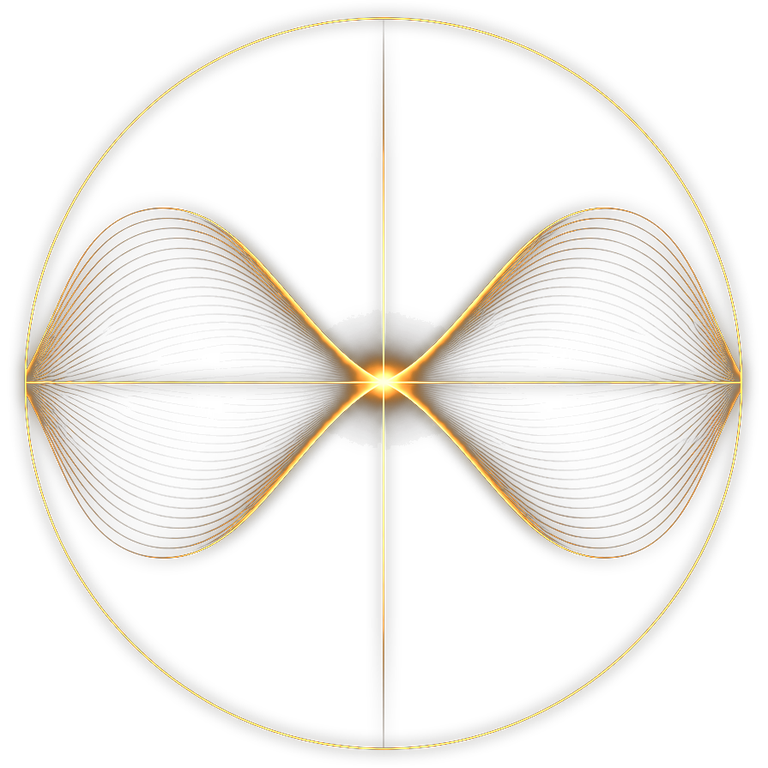
Visualisation 01
Concentric Phase Rings.
A conceptual model for exploring coherent phase propagation across coupled relational domains and its stated limitations.
A coherent phase disturbance propagates through coupled relational domains. Regions with stronger relational coupling reinforce coherence, while weakly coupled regions dissipate. The visualisation illustrates coherence redistribution across a connected system and is an educational conceptual model rather than a validated physical simulation.
Educational illustration · Synthetic display
How the display works
Update rule
Each animation frame, every ring radius grows by pulse speed × 0.016. A node whose distance from a ring centre is within 8 pixels of that ring's radius gains activity (0.55 × ring amplitude, capped at 1.6). A node above 0.9 may emit a secondary ring of amplitude 0.45, with probability 0.6 × coupling, at most once every 900 ms. Activity is then multiplied by the damping value each frame. With automatic pulses on, a new ring starts every 1.8 seconds.
Displayed readings
"Coherence" is the mean of each node's activity capped at 1, shown as a percentage. It is a display score specific to this tool, not a measured physical coherence. "Velocity" is the pulse-speed setting in pixels per second of animation. "Domains" counts nodes and "Sources" counts active pulse origins.
Simulation units
Distances are screen pixels and time is animation time. Neither is mapped to a physical length or clock.
Visual choices
Node positions are random, the link distance grows with coupling, and colour shifts from blue to white with activity. These are presentation choices, not model results.
This conceptual model is not derived from the R00 to R13 foundations. Other tools in the Lab